Cleanroom Davit Cranes: Stainless Steel vs. Galvanized vs. Aluminum Corrosion Resistance
In cleanroom environments—such as GMP pharmaceutical facilities, semiconductor manufacturing plants, and biotechnology laboratories—material selection for material handling equipment is critical. Contamination control is the top priority, meaning that lifting equipment like davit cranes must not only possess high structural strength and corrosion resistance, but also meet strict particulate emission standards.
When engineering teams and facility managers evaluate lifting solutions, they frequently compare three primary metal materials: Stainless Steel, Aluminum, and Galvanized Steel.
This technical guide compares these materials across chemical resistance, particle emission, and cleanroom compatibility to help you select the optimal davit crane for your facility.
1. Chemical Resistance and Corrosion Testing
Cleanroom environments require frequent and rigorous sterilization protocols. Surfaces are regularly exposed to harsh chemical agents, including hydrogen peroxide, isopropyl alcohol (IPA), and chlorine-based sanitizers.
To evaluate long-term durability, we simulated accelerated chemical exposure tests (continuous exposure to pharmaceutical-grade cleaning agents for 500 hours):
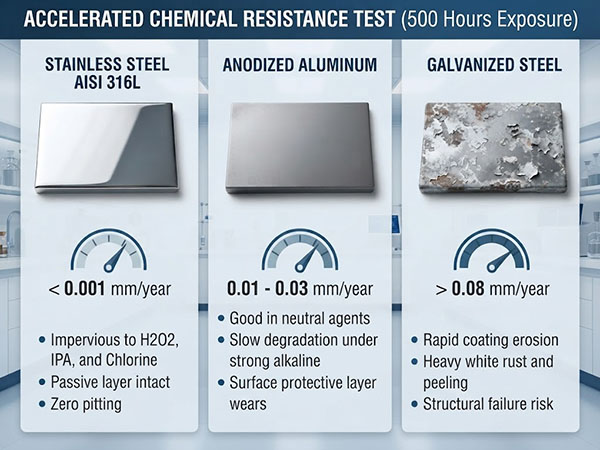
Stainless Steel (AISI 304 / 316L):
Corrosion Rate: < 0.001 mm/year
Surface Behavior: Demonstrates exceptional resistance to strong acids, bases, and oxidizing disinfectants. The passive chromium oxide layer remains intact, showing no pitting or degradation.
Aluminum (Anodized Finish):
Corrosion Rate: 0.01 - 0.03 mm/year
Surface Behavior: Good performance under neutral and mild conditions, but long-term contact with highly alkaline cleaning solutions can slowly degrade the protective anodic oxide film.
Galvanized Steel:
Corrosion Rate: > 0.08 mm/year
Surface Behavior: Highly susceptible to chemical attack. Disinfectants rapidly erode the zinc coating, leading to white rust formation and rapid degradation.
2. Particle Emission and Cleanroom Compatibility
In controlled environments, mechanical friction and surface wear can generate microscopic debris that compromises cleanroom standards.
Stainless Steel: Generates zero particle shedding. Its dense crystal structure and smooth electropolished surface prevent dust accumulation and wear debris. It is fully compatible with ISO Class 3 to ISO Class 7 cleanrooms.
Aluminum: Exhibits very low particle emission when properly anodized. However, if the surface suffers deep mechanical scratches, raw aluminum exposure can introduce microscopic particulate risks. It is generally suitable for ISO Class 5 to ISO Class 8 zones.
Galvanized Steel: Poses a high contamination risk. Under routine mechanical operation and chemical wipe-downs, the zinc layer tends to flake and peel, releasing zinc dust particles into the air. Galvanized steel is strictly prohibited in sterile and high-class cleanrooms.
3. Summary Performance and Material Selection Matrix
Performance Metric | Stainless Steel | Aluminum | Galvanized Steel |
Chemical Disinfectant Resistance | ⭐⭐⭐⭐⭐ (Outstanding) | ⭐⭐⭐ (Good) | ⭐ (Poor, prone to flaking) |
Particle Shedding Control | ⭐⭐⭐⭐⭐ (Zero Shedding) | ⭐⭐⭐⭐ (Excellent) | ⭐ (High risk of zinc flaking) |
Structural Rigidity & Load Capacity | ⭐⭐⭐⭐⭐ (Very High) | ⭐⭐⭐ (Moderate) | ⭐⭐⭐⭐⭐ (Very High) |
Weight & Portability | ⭐⭐⭐ (Heavier) | ⭐⭐⭐⭐⭐ (Lightweight) | ⭐⭐⭐ (Moderate) |
Recommended Cleanroom Application | GMP Pharma, Semiconductors, Sterile Labs | Lightweight, portable, and mobile cleanroom areas | General industrial plants, outdoor use (Not for cleanrooms) |
Conclusion: Which Material Should You Choose?
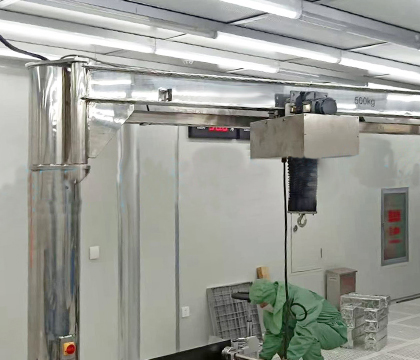
Choose Stainless Steel Davit Cranes when your facility demands maximum corrosion resistance against harsh cleaning chemicals and absolute cleanliness (zero particle risk) for pharmaceutical or semiconductor production.
Choose Aluminum Davit Cranes when you require a lightweight, portable lifting solution that can be easily moved across different cleanroom zones without heavy manual strain.
Avoid Galvanized Steel entirely in controlled environments, as its coating degradation directly violates cleanroom contamination protocols.
Are you planning a cleanroom material handling project? Contact our engineering team today for a custom, contamination-free davit crane solution tailored to your exact load and cleanroom class requirements. If you are ready to explore specific cleanroom lifting solutions, check out our in-depth Portable Stainless Steel Davit Crane.